Historical & Geological Context
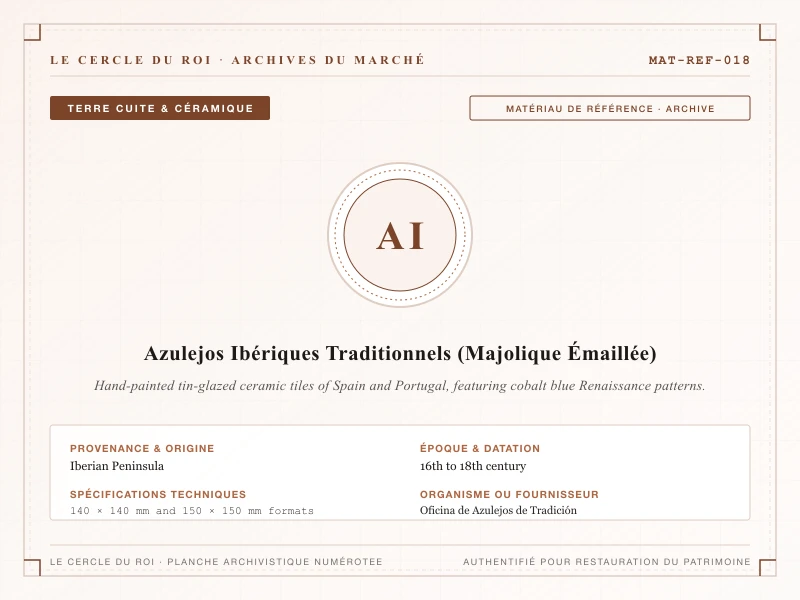
The Iberian azulejo represents five centuries of glazed ceramic mastery. Dating back to Hispano-Moresque lusterware and developed into monumental blue-and-white panels in the 17th and 18th centuries, each tile is hand-painted over raw tin glaze before firing. Essential for restoring Portuguese quintas, Andalusian patios, and cloister walls.
Petrographic & Geological Characteristics
Majolica tin-glazed earthenware tiles, Iberian clay body, polychrome oxide enamels.
Lime Mortar & Breathability Compatibility
Bed exclusively in pure aerial lime mortar; moisture evaporating through the joints protects the glaze from spalling.
Provenance & Historical Sourcing
Seville, Toledo, and Lisbon workshops.
Condition Report & Patina
Museum-grade conservation cleaning; suitable for interior and shaded courtyard facades.
Azulejos Ibériques Traditionnels (Majolique Émaillée)
Iberian Peninsula (ES)
Non-commercial reference. Not sold or brokered by Le Cercle du Roi.
This material dossier is compiled from public geological surveys, heritage conservation research (BRGM, CTMNC, Historic England, Monumentenwacht), and historical treatises. Inclusion does not constitute a sales offer by Le Cercle du Roi.