Historical & Geological Context
Bath Stone is an oolitic limestone quarried from subterranean mines in Somerset and Wiltshire. Soft and freely workable in all directions when unmined (freestone), it develops a protective case-hardened crust upon air exposure. Its rich honey-gold tone defines the Georgian terraces of Bath (Royal Crescent) and fine English country mansions.
Petrographic & Geological Characteristics
Warm honey-coloured oolitic limestone (Middle Jurassic Great Oolite), freestone extracted at Combe Down.
Lime Mortar & Breathability Compatibility
Bed with pure slaked lime (CL90) or feebly hydraulic lime (NHL 2) with local stone dust aggregates.
Provenance & Historical Sourcing
Somerset subterranean mines; Combe Down and Monks Park beds.
Condition Report & Patina
Must be laid strictly on its natural quarry bed; requires lime mortars and gentle water wash.
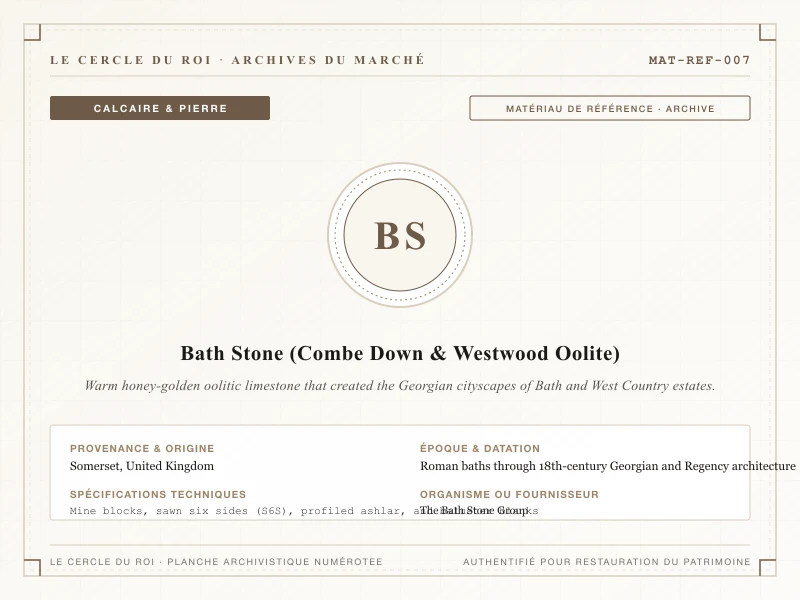
Bath Stone (Combe Down & Westwood Oolite)
Somerset, United Kingdom (GB)
Non-commercial reference. Not sold or brokered by Le Cercle du Roi.
This material dossier is compiled from public geological surveys, heritage conservation research (BRGM, CTMNC, Historic England, Monumentenwacht), and historical treatises. Inclusion does not constitute a sales offer by Le Cercle du Roi.