Historical & Geological Context
Sweet chestnut (Castanea sativa) split along the natural medullary rays with a froe (départoir) produces roofing shingles (bardeaux or tavaillons) that last up to a century without chemical treatment. The natural abundance of tannins deters wood-boring insects and spiders, making it the premier ecological roofing material for historic church spires and mountain manors.
Petrographic & Geological Characteristics
Sweet chestnut (Castanea sativa), coppiced heartwood, cleft along radial wood grain.
Lime Mortar & Breathability Compatibility
Natural high tannin content provides exceptional rot resistance without chemical preservatives.
Provenance & Historical Sourcing
Coppiced chestnut woodlands of Limousin and Cévennes.
Condition Report & Patina
Cleft split (not sawn); intact wood fibers shed water naturally.
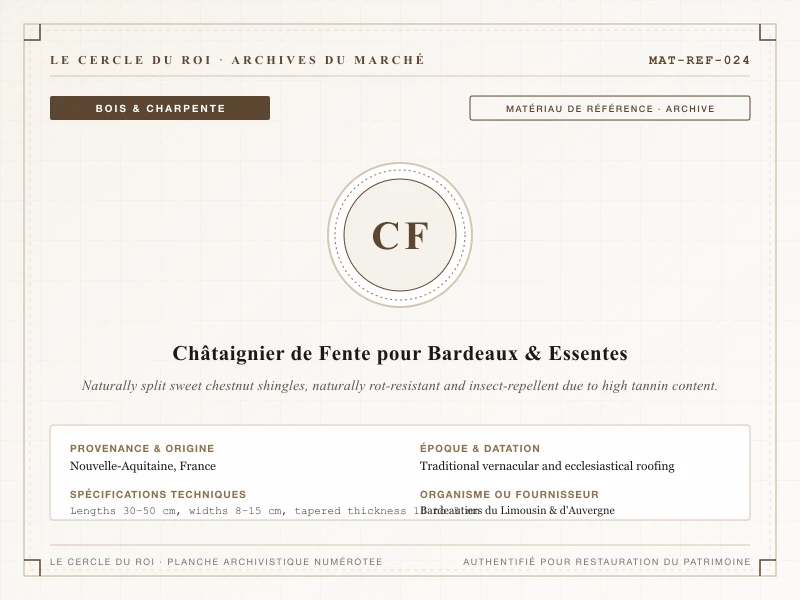
Châtaignier de Fente pour Bardeaux & Essentes
Nouvelle-Aquitaine, France (FR)
Non-commercial reference. Not sold or brokered by Le Cercle du Roi.
This material dossier is compiled from public geological surveys, heritage conservation research (BRGM, CTMNC, Historic England, Monumentenwacht), and historical treatises. Inclusion does not constitute a sales offer by Le Cercle du Roi.