Historical & Geological Context
Marine-grade timber requires unique mechanical characteristics: French elm (orme) for underwater structural keels and garboards because it does not split under water; ash (frêne) for traditional blocks, tiller handles, and oars due to high shock-absorbing elasticity; and curved oak for structural knees and breasthooks. Seasoned under water and air to prevent internal checking.
Petrographic & Geological Characteristics
Naturally compass-curved oaks, field elm (Ulmus minor), and white ash (Fraxinus excelsior).
Lime Mortar & Breathability Compatibility
Historical naval timbers chosen for natural grain curvature; essential for knee braces and frames.
Provenance & Historical Sourcing
Selected Atlantic and Baltic timber reserves.
Condition Report & Patina
Naturally air-seasoned, high fiber cohesion, marine surveyed.
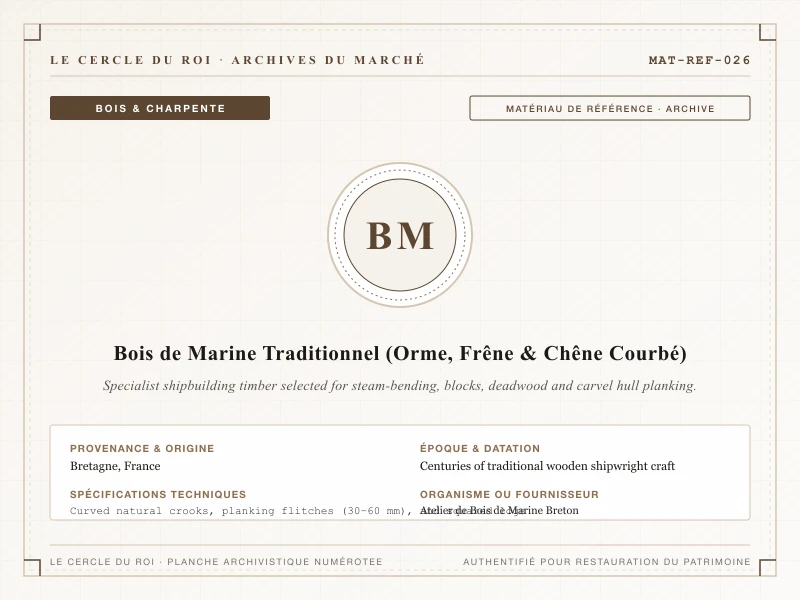
Bois de Marine Traditionnel (Orme, Frêne & Chêne Courbé)
Bretagne, France (FR)
Non-commercial reference. Not sold or brokered by Le Cercle du Roi.
This material dossier is compiled from public geological surveys, heritage conservation research (BRGM, CTMNC, Historic England, Monumentenwacht), and historical treatises. Inclusion does not constitute a sales offer by Le Cercle du Roi.