Historical & Geological Context
Unlike modern fine industrial gypsum, traditional Plâtre Gros is burned in artisanal wood-fired kilns from Montmartre and Cormeilles gypsum quarries. The irregular wood burning creates a mix of fast- and slow-setting hydrates, resulting in a dense, breathable, warm-grey plaster historically used over lath ceilings and timber-frame fachwerk.
Petrographic & Geological Characteristics
Paris Basin natural gypsum (Lutetian), wood-kiln calcined at 150-200°C.
Lime Mortar & Breathability Compatibility
Traditional 'plâtre gros' for exterior facades and timber framing; completely breathable when unprotected by modern acrylic paints.
Provenance & Historical Sourcing
Parisian Basin gypsum deposits.
Condition Report & Patina
Artisanal coarse grind with natural charcoal specks from wood firing.
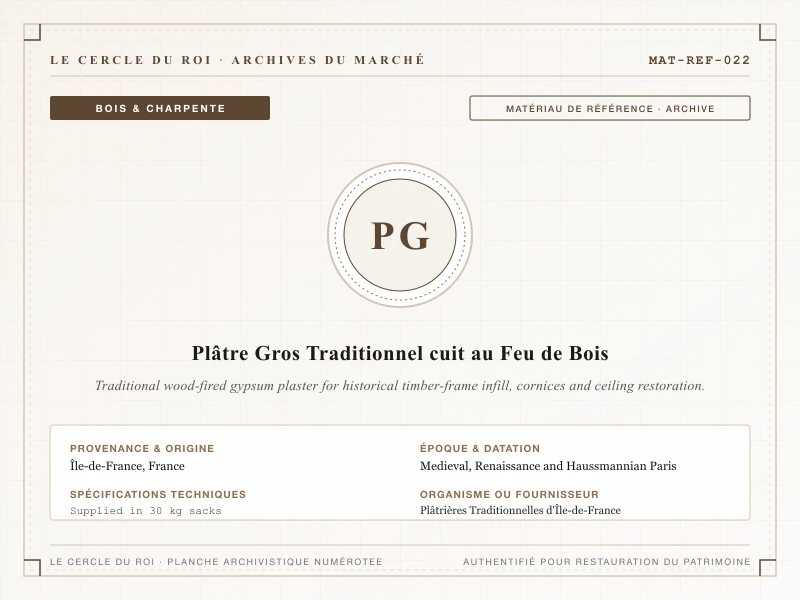
Plâtre Gros Traditionnel cuit au Feu de Bois
Île-de-France, France (FR)
Non-commercial reference. Not sold or brokered by Le Cercle du Roi.
This material dossier is compiled from public geological surveys, heritage conservation research (BRGM, CTMNC, Historic England, Monumentenwacht), and historical treatises. Inclusion does not constitute a sales offer by Le Cercle du Roi.