Historical & Geological Context
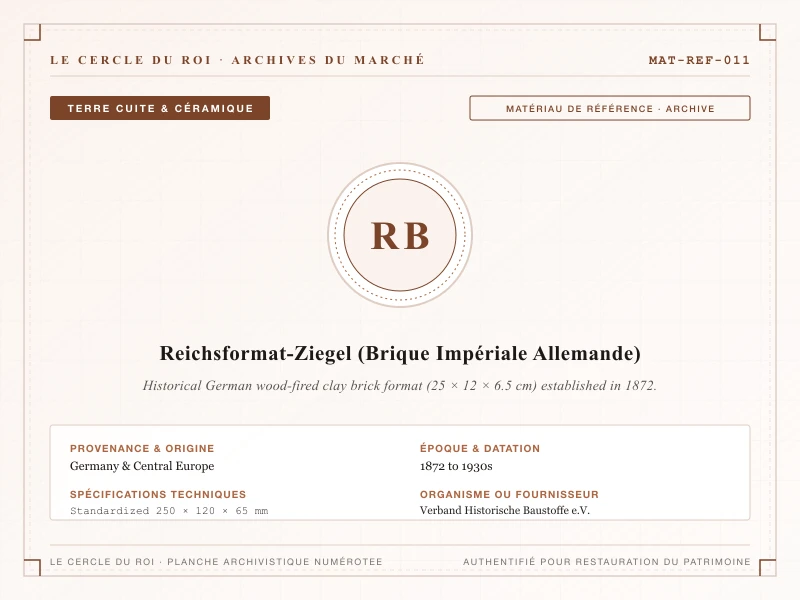
Established by decree in Prussia in 1872, the Reichsformat brick (250 × 120 × 65 mm) standardized industrial and estate architecture across Central Europe. Heavier and denser than modern metric bricks, its rough texture and mineral variations are essential for authentic brick restoration in Germany, Poland, and Alsace.
Petrographic & Geological Characteristics
Historical standardized clay brick (250 × 120 × 65 mm), wood-fired, porous brick body.
Lime Mortar & Breathability Compatibility
Bed in soft aerial or weak hydraulic lime (NHL 2); cement mortars cause catastrophic face-shell spalling.
Provenance & Historical Sourcing
Central European 19th-century salvage.
Condition Report & Patina
Must be laid with flexible lime mortar to avoid face spalling.
Reichsformat-Ziegel (Brique Impériale Allemande)
Germany & Central Europe (DE)
Non-commercial reference. Not sold or brokered by Le Cercle du Roi.
This material dossier is compiled from public geological surveys, heritage conservation research (BRGM, CTMNC, Historic England, Monumentenwacht), and historical treatises. Inclusion does not constitute a sales offer by Le Cercle du Roi.